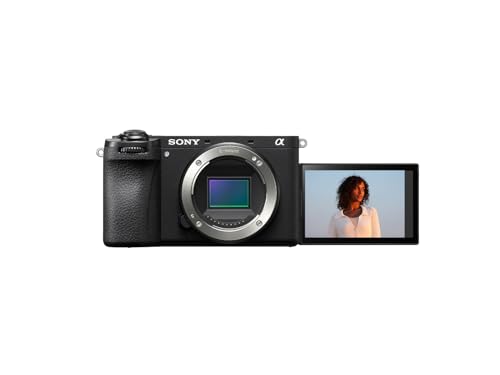
Sony’s a6000 line has long been the default recommendation for a compact camera with a big lens catalog. The a6700 is Sony’s most advanced APS-C body in that line, announced in 2023 with an AI processing unit borrowed from the full-frame a7R V. It is smaller and lighter than the full-frame cameras in our ranking, it shares their lens mount, and it is the one many enthusiasts consider when they want one camera for travel, family, video and the occasional bird. For all ten cameras, see our ranking of the best mirrorless cameras of 2026.
We have not handled this camera, and we take no measurements of our own. Sony’s own shop pages did not open for us, so this profile relies on a reposting of Sony’s US press text and a second article that repeats it. Engadget’s launch coverage fills in a few details such as burst speed and the card slot. Battery life is not listed in what we opened, and we flag that gap instead of filling it from memory.
Sensor and Processor
Sony’s press text describes an APS-C back-illuminated Exmor R CMOS sensor with about 26 effective megapixels and the BIONZ XR processing engine. Standard ISO runs from 100 to 32000 for stills and movies. At 26 megapixels, files stay manageable and you still have room to crop.
APS-C means a smaller sensor than full frame. With Sony’s APS-C cameras the crop factor is about 1.5, which makes a 200mm lens frame like a 300mm lens would on a full-frame body. That extra reach is the main reason wildlife photographers on a budget look at APS-C. The trade-off is less light-gathering ability, which shows up as more noise in dim conditions than on a full-frame camera.
Autofocus and AI Recognition
The big upgrade is the autofocus. Sony says the AI processing unit supports Real-Time Recognition AF, which identifies subjects including humans, animals, birds, insects, cars and trains, and airplanes. The company also lists an AI-driven Auto Framing function for video that tracks a subject without manual camera movement. Sony notes that the AI works from data-based inference and may not recognize every subject in every condition.
For birds and pets, recognition does a lot of the work: you point at the subject and the camera finds the eye. For sports or wildlife, remember that the lens matters as much as the body: a slow-focusing lens limits what any camera can do.
Stabilization
Sony describes optical five-axis in-body stabilization with a shutter speed advantage of 5.0 stops for stills. That is a more modest rating than the figures Canon and Nikon give their full-frame bodies, and ratings differ by test method, so treat it as a rough guide. Because the lens catalog includes many stabilized lenses, you can combine lens and body stabilization.
Video
Sony lists 4K up to 120 fps, oversampled from 6K-equivalent data, plus S-Log3 with 14+ stops of latitude and the S-Cinetone picture profile. Oversampling means the camera reads more data than it needs and squeezes it down, which usually gives sharper video. For color graders, S-Log3 offers flexibility. For people who want a good look with no grading, S-Cinetone is a ready-made cinematic profile.
The rear screen is a touch-operable vari-angle LCD, so it swings out and faces forward. That makes the a6700 a more natural vlogging camera than the Fujifilm X-T5, whose tilting screen does not face forward. The camera also has a Multi-Interface shoe that supports digital audio accessories such as Sony’s ECM-M1 microphone, which Sony launched alongside it. Engadget’s launch coverage also lists microphone and headphone ports, so a wired mic works too.
Size and Weight
Sony gives the weight as about 1 lb 1.4 oz and the size as roughly 4 7/8 by 2 3/4 by 3 inches. That is compact enough to carry all day, and a fraction of the weight of a full-frame body such as the Canon EOS R6 Mark III at about 1.54 lb (699 g) with battery and card. The size advantage grows when you add lenses, because APS-C lenses are smaller and lighter.
Burst Speed, Viewfinder and Card Slot
According to Engadget’s launch coverage, the a6700 shoots bursts at 11 fps in both mechanical and electronic shutter modes with autofocus and auto-exposure tracking, uses a 2.36-million-dot electronic viewfinder with a fast 120 fps refresh, and has a single SD UHS-II card slot on the side of the body. Engadget also describes it as dust and moisture resistant. That is not a promise that the camera is waterproof, so protect it in heavy rain. We could not confirm a battery-life rating from a page we opened, so check Sony’s spec page before you buy.
How It Fits a Lens Budget
An APS-C body changes how you spend money. Lenses made for the smaller sensor are smaller and usually cheaper than their full-frame equivalents, so the same budget buys a more capable kit. A common approach is to start with one versatile zoom and add a fast prime and a telephoto over time. Full-frame lenses work on the a6700 but are larger and heavier than they need to be, which gives up some of the size advantage that drew you to APS-C. If you may move to full frame later, buying full-frame lenses now saves you from rebuying them, at the cost of a bulkier kit today.
Who Should Buy the a6700
- One-camera households that want a body for travel, family and video.
- Beginners who want room to grow. The camera has an automatic mode and lots of manual control.
- Budget wildlife and bird photographers, who gain reach from the crop factor and recognition of birds.
- Creators who want 4K 120p and a flip-out screen without moving to full frame.
- Sony owners with older E-mount lenses who want modern autofocus.
Who Should Look Elsewhere
If you want the fastest possible burst and pre-capture, the Sony a7 V lists 30 fps with pre-capture. If you want a body with internal RAW video, look at the Nikon Z6III.
If you want large high-resolution files and dials, the Fujifilm X-T5 is a better fit.
If you want the smallest, least expensive way into vlogging, the same E-mount lineup includes lighter vlogging-focused cameras, covered in our full ranking.
Choosing a Lens
The listing is for the body only. E-mount has one of the widest selections of third-party lenses of any mirrorless system, and many are designed for APS-C. A standard zoom is the sensible first lens. A fast prime gives you shallow depth of field and low-light performance. For birds, a telephoto zoom takes advantage of the crop factor. You can also mount full-frame E-mount lenses on the a6700, which keeps your options open if you upgrade to a full-frame Sony later.
Bottom Line
The Sony a6700 is a compact, capable APS-C camera that borrows the best of Sony’s full-frame autofocus and puts it in a small body. It is a good buy for people who want one flexible camera. Check the battery rating on Sony’s spec page, then read the full ranking to see how it compares with the other nine.
See price on Amazon
Sources