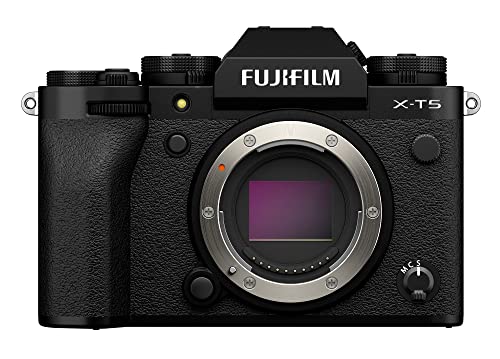
Few cameras have as much personality as the Fujifilm X-T5. It is a stills-first body with physical dials for the settings photographers change most, a high-resolution APS-C sensor and a compact, classic shape. It is a camera for people who want to feel the settings under their fingers. This page covers what Fujifilm says it can do, who will love it, and who will be happier elsewhere. For the whole field, see our ranking of the best mirrorless cameras of 2026.
We have not handled this camera, and we take no measurements of our own. The facts below come from Fujifilm’s official product page, which opened for us. The page does not list every spec, and we say so where it matters.
Sensor and Processor
According to Fujifilm, the X-T5 has a 40.2-megapixel X-Trans CMOS 5 HR back-side illuminated sensor and the X-Processor 5, which Fujifilm says offers twice the processing speed of X-Processor 4. X-Trans is the name Fujifilm gives its sensor design.
APS-C is a smaller sensor format than full frame. With Fujifilm’s APS-C cameras the crop factor is about 1.5, so a lens behaves like one about one and a half times longer than its stated focal length on a full-frame camera. That is a bonus for wildlife and distant subjects, and a small drawback for wide-angle landscapes, where you buy wider lenses to compensate. The trade for the smaller sensor is a smaller, lighter body and smaller lenses.
Forty megapixels is a lot. You get room to crop and large prints, and in return files are bigger. Plan on larger and faster memory cards and more hard drive space than you would for a 24-megapixel camera.
Stabilization
Fujifilm lists five-axis in-body image stabilization of up to 7.0 stops. That rating is a best case under lab conditions. High-resolution sensors reveal tiny shakes, so stabilization is especially valuable here, and it lets you handhold slower shutter speeds with sharp results.
Dials and Handling
The three top-plate dials for ISO, shutter speed and exposure compensation are the soul of the X-T5. You can read the main exposure settings at a glance, even with the camera switched off. Fujifilm says most XF lenses also have an aperture ring, so the whole exposure triangle is under your fingers.
If you come from a camera that routes everything through menus and command dials, this can feel slow at first and natural after a week. If you prefer to shoot in a fully automatic mode, you will use less of what makes the camera special.
Fujifilm lists the weight as 1.23 lb (557 g) body only. That is lighter than the full-frame bodies in our ranking, such as the Canon EOS R6 Mark III at about 1.54 lb (699 g) with a battery and card.
Screen and Viewfinder
The rear screen is a 1.84-million-dot three-way tilting LCD. It tilts up and down and also sideways for vertical shooting, but it does not swing out and rotate to face forward the way a vari-angle screen does. For vlogging, that is a real limitation. If you plan to film yourself, the Sony a6700 with its vari-angle touchscreen is easier to live with.
The electronic viewfinder is a 3.69-million-dot panel with 0.8x magnification, a sharp finder that makes manual focusing and careful composition easier.
Video
Fujifilm lists internal 6.2K video at 30p in 4:2:2 10-bit, F-Log2 with a stated range of 13+ stops based on Fujifilm’s internal testing, and RAW output over HDMI to ATOMOS or Blackmagic Video Assist 12G recorders at up to 6.2K and 29.97 fps. That is a strong list for a stills-first camera, but note the 30p ceiling at 6.2K. If slow motion matters, check Fujifilm’s page for the 4K and Full HD frame rates. We did not find them on the page we opened.
Battery, Cards and Weather Sealing
Fujifilm lists about 740 still images in economy mode, up from about 600 on the X-T4. That is a favorable figure for a mirrorless camera, although economy mode lowers the screen and viewfinder refresh rates, so expect fewer shots in normal use.
There are two SD slots, both UHS-II compatible. That means no expensive CFexpress cards are needed, which keeps memory costs down. The body has 56 weather-sealed points and is rated to operate at temperatures as low as 14 degrees Fahrenheit (-10 degrees Celsius).
Who Should Buy the X-T5
- Travel and street photographers who want a small body with big files.
- Landscape photographers who value resolution and dedicated dials for exposure.
- People who enjoy the process, who like turning a dial and seeing the setting.
- Photographers who like to get a finished look in the camera and spend less time editing.
Who Should Look Elsewhere
If you shoot fast action or wildlife, the page we opened does not list a burst speed, and the APS-C sensor does not offer the same stacked-sensor speed as the Sony a7 V or the Nikon Z6III. Look at those instead, and check Fujifilm’s page for the burst rate if you are still considering the X-T5.
If you vlog or film yourself often, you want a screen that faces forward. The X-T5’s tilting screen does not.
If you prefer to let the camera choose the settings, a more automatic camera may be easier to enjoy.
Living With a 40-Megapixel File
High resolution changes your workflow in small ways. Raw files from a 40-megapixel sensor are larger than those from a 24-megapixel camera, so a day of shooting fills cards faster and your editing software works harder. Sharp technique matters more too, because the sensor shows camera shake and slight focus errors that a lower-resolution camera would hide. That is where the stabilization rating helps, and why a solid tripod and a good lens are worth the money for landscape work. If you mostly share photos on social media, you will rarely use all of those pixels. If you print large or crop heavily, you will be glad to have them.
Choosing a Lens
The listing is for the body only. Fujifilm’s X-mount lens range is built around APS-C, so lenses tend to be compact. Because the sensor resolves so much detail, it deserves good lenses. A standard zoom is the safe first lens, and a small prime gives you a pocketable street kit. Many XF lenses have aperture rings that match the body’s dial layout.
Bottom Line
The Fujifilm X-T5 is a joy for photographers who like control and resolution in a small body. It trades speed and vlogging convenience for dials, high resolution and a compact size. Choose it if stills are your priority. To compare it with the other nine cameras, read the full ranking.
See price on Amazon
Sources