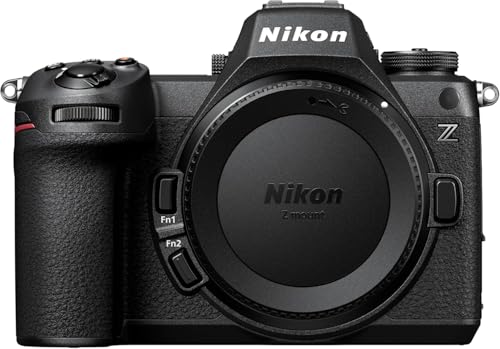
The Nikon Z6III moved Nikon’s mid-range full-frame line into stacked-sensor territory. Announced June 17, 2024, it uses what Nikon describes as the first partially stacked full-frame sensor in a mirrorless camera, together with the EXPEED 7 processor that powers the flagship Z8 and Z9. This profile covers the published specifications, who will like it, and where another body is the better buy. For all ten cameras side by side, see our ranking of the best mirrorless cameras of 2026.
We have not handled this camera, and we take no measurements of our own. The facts below come from Nikon’s own release and lineup pages. Nikon’s US shop page would not open for us. Where Nikon does not publish a number, we say so rather than guess.
Sensor, Processor and Autofocus
Nikon’s release lists a 24.5-megapixel full-frame (FX) partially stacked CMOS sensor and the EXPEED 7 processor. Twenty-four megapixels is a sensible resolution for most photographers: files are manageable, low-light noise is lower than on very high-resolution sensors, and you still have room to crop.
Subject detection covers nine types, including an airplane mode, and Nikon says autofocus works down to -10 EV in low light. Nikon’s lineup page also lists 3D tracking. For birds, pets and kids, that is the kind of tracking you want, though no autofocus system is perfect in every scene.
Burst Speed
The mechanical shutter shoots about 8.1 fps, according to Nikon’s lineup page. In extended high-speed mode, the electronic shutter reaches about 20 fps, and High-speed frame capture+ climbs to as much as 120 fps. Nikon’s figures are maximums measured in its own in-house tests, and the page notes the fastest modes record JPEG images rather than NEF RAW. At 60 fps Nikon says the camera still captures images of about 24 megapixels.
Pre-Release Capture buffers up to one second of frames before the shutter is fully pressed, again JPEG only. If you shoot RAW, the practical burst rate is the 20 fps figure. Compare that with the Canon EOS R6 Mark III, which lists 40 fps and pre-capture in RAW, or the Sony a7 V, which lists 30 fps in 14-bit RAW.
Stabilization
Nikon calls the Z6III’s vibration reduction the most powerful in the Z series and equates it to 8.0 stops under CIPA standards. The rating was measured with the NIKKOR Z 24-120mm f/4 S at the telephoto end in Normal mode, so treat it as a best case. The camera also offers electronic vibration reduction for video and a Focus-point VR mode for photos with non-VR lenses.
Screen and Viewfinder
The rear screen is a 3.2-inch vari-angle touchscreen of about 2.1 million dots with a wide viewing angle. Because it swings out to the side and rotates, you can see yourself while recording, shoot from low angles, and fold it flat against the body to protect it.
The electronic viewfinder is the headline. Nikon lists a 5,760k-dot panel rated at 4,000 cd/m2 with a DCI-P3 equivalent color gamut. A bright EVF matters outdoors in strong sun, where many viewfinders wash out. If you shoot landscapes at midday or sports in open stadiums, this is a real advantage.
Video
Nikon lists internal 12-bit 6K N-RAW and ProRes RAW HQ, 10-bit 5.4K ProRes 422 and H.265, 4K UHD up to 60p oversampled from 6K, and 10-bit Full HD up to 240p. Nikon says 4K 60p can run for up to 125 minutes under its test conditions. Its lineup page lists RAW video up to 6K at 60p and 4K up to 120p.
Internal RAW at this level is unusual in a camera of this class, and it makes the Z6III one of the few alternatives to Canon’s RAW-capable R6 Mark III. For people who shoot straight to 10-bit files, the H.265 and ProRes options are also strong.
Body, Cards and Battery
Nikon lists two card slots that accept CFexpress Type B, XQD and UHS-II SD cards. The body weighs about 1 lb 7.7 oz (670 g) alone and about 1 lb 10.9 oz (760 g) with a battery and memory card. The camera uses one EN-EL15c battery, and Nikon says older EN-EL15b and EN-EL15a batteries work but give fewer shots per charge. The optional MB-N14 battery pack holds two EN-EL15c cells and Nikon says it extends shooting by about 1.9 times. We did not find a CIPA shot count on the pages we opened.
Who Should Buy the Z6III
- Hybrid shooters who want internal RAW video and a flip-out screen in one body.
- Photographers who shoot in bright light, thanks to the 4,000-nit viewfinder.
- Current Nikon Z owners who want to move up from a Z6 or Z6II, or from an F-mount DSLR with an adapter.
- Action and family photographers who like subject detection and a fast electronic burst, and who are fine with JPEG for the fastest modes.
Who Should Look Elsewhere
If you want RAW at the very highest burst rates, the Canon EOS R6 Mark III lists 40 fps and RAW pre-capture.
If weight and size matter most, the Z6III is not light. An APS-C body such as the Fujifilm X-T5 is lighter, and the Sony a6700 is lighter still.
If you do not need full frame, spend the difference on lenses. A good lens often changes your pictures more than a bigger sensor does.
How the Z6III Compares
On paper, the Z6III sits between the Sony and the Canon. It shoots slower than both in RAW at the top end, but its 4,000-nit viewfinder is a standout among the specs we compared, and its vari-angle screen folds flat against the body. Its resolution is also the lowest of the three, at 24.5 megapixels against 32.5 for the Canon and about 33 for the Sony, which means smaller files and a little less room to crop. Whether that matters depends on how you print and how you shoot. Most people never need more than 24 megapixels.
Choosing a Lens
The listing is for the body only. A standard zoom is the sensible first lens for travel and family use, and Nikon’s own stabilization rating was measured with a 24-120mm f/4 zoom, a hint at the kind of lens it pairs with. For wildlife and sports you will need a longer lens, and Nikon’s Z mount has a growing selection of telephotos. The mount is wide and short, which gives lens designers room, and an adapter lets you use older F-mount lenses. Check that an adapted lens keeps autofocus and stabilization before you rely on it.
Bottom Line
The Nikon Z6III is an excellent all-round full-frame camera. Its best qualities are the bright viewfinder, the vari-angle screen and internal RAW video, and its weaknesses are the JPEG-only pre-capture and the weight. If those fit how you shoot, it is a strong pick. The full ranking shows where it sits against the other nine cameras.
See price on Amazon
Sources