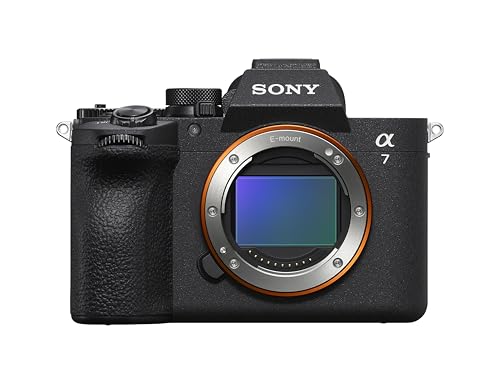
The a7 series is Sony’s all-rounder line, and the a7 V is the latest version of it. Sony announced the camera on December 2, 2025, and the headline change is the sensor: a new 33-megapixel, partially stacked, full-frame Exmor RS chip, paired with the BIONZ XR2 processor and its built-in AI unit. That combination lifts the camera from a very good all-rounder into territory once reserved for action bodies. For the full field of competitors, see our ranking of the best mirrorless cameras of 2026.
We have not handled this camera, and we take no measurements of our own. Everything below comes from the manufacturer’s announcement as reported by the trade press, plus our own comparison of the published specifications. Sony’s own shop page would not open for us, so where a number comes from a news site, we say so.
What Is New in the a7 V
According to Sony’s announcement coverage on TV Technology, the sensor has about 33.0 effective megapixels and the processor adds an integrated AI processing unit. Sony claims continuous shooting of up to 30 fps with autofocus and exposure tracking, including 14-bit RAW, with no viewfinder blackout. Engadget adds that the mechanical shutter tops out at about 10 fps. The camera can also record up to one second of images before you press the shutter all the way down, a feature Sony calls pre-capture, which matters for birds, pets and anything that moves before you can react.
Autofocus uses 759 phase-detection points that cover up to 94% of the frame. Sony says the system works down to EV -4.0 and runs its calculations up to 60 times per second. Subject detection is handled by what Sony calls Real-Time Recognition AF, and the camera also offers an AI-based Auto Framing mode that keeps a subject composed while you record video.
Stabilization and Handling
Engadget reports five-axis in-body stabilization rated at up to 7.5 stops. Manufacturers measure these ratings with a specific lens at a specific focal length, so read the figure as a best case, not a promise for every lens. The rear screen is a 2.1-million-dot panel that both tilts and flips out, which Sony calls a four-axis design, and the electronic viewfinder is an OLED panel of roughly 3.7 million dots.
We could not find a weight figure in the pages we opened. If a light travel body matters to you, check Sony’s spec page and compare it with Sony’s compact full-frame a7C II.
Ports are modern. TV Technology says there are dual USB Type-C ports and Wi-Fi 6E support, which helps if you tether to a laptop or transfer large files over a fast network.
Video Features
For video, the a7 V records 4K at up to 60p using the full width of the sensor, oversampled from 7K, with 10-bit S-Log3 available. Sony lists 4K at 120p, but only in an APS-C (Super 35) crop, which means your lens looks tighter than it does in full-frame mode. Engadget says the camera can record 4K 60p for up to 90 minutes continuously and that it has no internal or external RAW recording; it uses XAVC H.265 and H.264 formats only.
That last point is where the a7 V gives ground to its rivals. Canon’s EOS R6 Mark III records 7K RAW internally, and Nikon’s Z6III offers internal 6K N-RAW and ProRes RAW. If you grade footage heavily or work with a post-production team that expects RAW files, one of those two is a better fit. For hybrid shooters who deliver finished 10-bit files straight from the camera, the a7 V’s formats are plenty.
Battery and Storage
The camera uses Sony’s NP-FZ100 battery. Engadget cites a CIPA rating of 750 shots. CIPA is the industry standard for comparing stills battery life, but it assumes a particular shooting pattern, so bursts, video and heavy screen use will cut into it. Sony’s own spec pages list slightly different numbers depending on whether you use the viewfinder or the screen, so confirm which figure you are comparing.
Engadget describes the card setup as a hybrid slot that takes CFexpress Type A or SD UHS-II, plus a second SD UHS-II slot, while noting that its own wording is somewhat unclear. Treat that as a lead to verify on Sony’s page. The practical advice is the same either way: if you plan to shoot long 30 fps bursts, budget for a fast card, and do not rely on a slow SD card for sustained action.
Who Should Buy the a7 V
The a7 V suits these buyers:
- Hybrid shooters who want one camera for photos and finished 4K video without a RAW workflow.
- Wildlife, sports and family photographers who benefit from 30 fps, pre-capture and subject recognition.
- Sony owners with E-mount lenses who want to move up from an older body without changing systems. E-mount has one of the widest lens selections of any mirrorless system, including many third-party options.
- Enthusiasts moving up from APS-C, who will see the largest jump in low-light performance and background blur from the move to full frame.
Who Should Look Elsewhere
If RAW video is non-negotiable, the Canon EOS R6 Mark III and the Nikon Z6III both record it internally, as the sources below describe. Their profiles are here: Canon EOS R6 Mark III and Nikon Z6III.
If you want the smallest, lightest kit possible, remember that a full-frame body plus a fast zoom is always heavier than an APS-C camera and lens. The Sony a6700 uses the same E-mount, so you can move to full frame later and keep your lenses.
If your budget is tight, remember that the body is only part of the cost. A good standard zoom, a spare battery, fast memory cards and a bag add up quickly. Because we do not list prices here, use the button below to see the current price and the exact configuration on Amazon.
Choosing a Lens
The listing is for the body only, so the lens decision is yours. For a general-purpose first lens on a full-frame E-mount body, a standard zoom covering wide-angle to short telephoto handles travel, family events and most video. A fast 35mm or 50mm prime is the budget route to shallow depth of field and low-light capability. For birds and wildlife you will want a telephoto zoom, and because the camera can crop to an APS-C area for 4K 120p, you also gain some reach in video. Third-party E-mount lenses are plentiful, so compare native and third-party options before you commit.
Pros and Cons at a Glance
On the plus side, the a7 V combines a fast sensor, deep subject recognition, stabilization rated up to 7.5 stops and a flexible screen in one body. On the minus side, there is no RAW video, 120p video is cropped, and we could not confirm weight or weather sealing in the pages we opened, so check those on Sony’s page before ordering if they matter to you.
Bottom Line
The Sony a7 V is a credible do-everything full-frame camera. It leans toward stills and finished video rather than RAW video workflows, and it rewards anyone who needs speed, whether for a bird in flight or a toddler in motion. If you are comparing it with the Canon and Nikon alternatives, read the full ranking and decide whether RAW video or E-mount lens choice matters more to you.
See price on Amazon
Sources