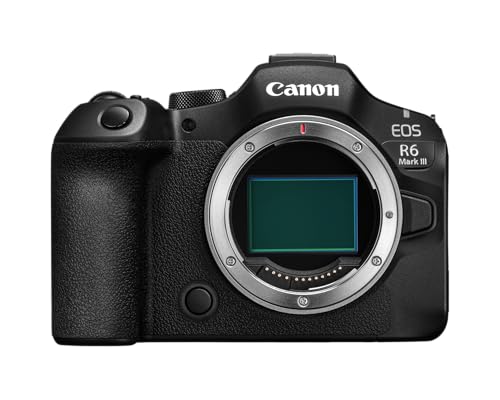
Canon’s EOS R6 series has long been the pick for photographers who want most of a flagship’s speed without the flagship’s size. The Mark III, announced November 6, 2025, keeps the familiar body but changes the sensor, the burst speed and the video options. This profile walks through what Canon says it can do, who will be happiest with it, and where a Sony or a Nikon makes more sense. For the full field, see our ranking of the best mirrorless cameras of 2026.
We have not handled this camera, and we take no measurements of our own. The numbers below come from Canon’s regional product and press pages (Canon’s US pages did not open for us), compared against rival specifications. Where a page gives no number, we say so.
Sensor, Processor and Autofocus
According to Canon, the R6 Mark III uses a 32.5-megapixel full-frame CMOS sensor with the DIGIC X processor and Dual Pixel CMOS AF II. The autofocus has 1,053 zones with up to 100% coverage, though Canon notes that conditions apply. Deep-learning subject detection recognizes people, dogs, cats, birds, horses and vehicles such as race cars, motorcycles, trains and airplanes.
Register People Priority is borrowed from the flagship EOS R1: it lets you store up to 10 faces and tells the camera to prefer them in a crowd. For event, wedding and family photographers, that is more useful than another megapixel.
Burst Speed and Pre-Continuous Shooting
Canon lists up to 40 frames per second with the electronic shutter and up to 12 fps with the mechanical or electronic first-curtain shutter. In Canon’s own test conditions, the company says the buffer holds about 330 JPEGs or about 150 RAW files at 40 fps with a 325GB CFexpress card, so a fast card is a must.
Pre-continuous shooting is the feature that matters most for wildlife and sports. It records up to 20 frames before you fully press the shutter, in RAW, C-RAW or HEIF and in any AF mode. Canon says it requires the electronic shutter and the high-speed continuous mode, and it does not work at shutter speeds slower than 1/30 second. If you photograph birds, you will use it constantly.
Stabilization
Canon rates the five-axis in-body stabilization at up to 8.5 stops at the center and 7.5 stops at the periphery. The rating follows the CIPA 2024 standard and was measured with the electronic shutter and the RF 24-105mm F2.8 L IS USM at 105mm. A rating like this is a best case with one particular lens, so expect less with a long, heavy telephoto and a moving subject. The camera also has a digital stabilization mode for movies.
Video
Video is where the Mark III separates itself. Canon lists internal 7K open gate (3:2) 30p 12-bit RAW, 7K 60p RAW Light, oversampled 4K DCI and UHD at up to 60p, and 4K up to 120p. Full HD goes up to nearly 180p for slow motion. Recording formats include Canon Log 2, Canon Log 3, HLG and HDR PQ, and Canon cites up to 15+ stops of dynamic range with Log 2 and Log 3. The camera has a waveform monitor, false color and zebras, and Canon’s Asia page says the maximum recording time for normal movies under 100 fps is approximately six hours.
Compare that with the Sony a7 V profile, where Sony has no RAW video option, and with the Nikon Z6III profile, which also records RAW internally. If you plan to color grade heavily, the Canon and the Nikon are the stronger choices.
Body, Cards and Battery
Canon’s Asia page gives the size as approximately 5.45 × 3.87 × 3.48 inches (138.4 × 98.4 × 88.4 mm) and the weight as approximately 1.54 lb (699 g) including the battery and a card. The chassis and back cover are magnesium alloy, the shutter is rated for 500,000 cycles, and the body is dust- and water-resistant when all openings are closed and the shoe cover is on.
The card setup is one CFexpress Type B slot and one SD slot that supports UHS-II. The battery is the LP-E6P, and an optional BG-R20 grip holds two. We could not find a battery-life rating in the pages we opened, so check Canon’s page and consider carrying a spare. Connectivity includes Wi-Fi, Bluetooth 5.1 and a 3.5 mm microphone input. We did not find screen or viewfinder specifications on the pages we opened.
Who Should Buy the R6 Mark III
- Wildlife and sports photographers who want 40 fps, pre-capture and animal and vehicle detection without paying for a flagship.
- Hybrid shooters who want internal RAW, Log and long recording times in a body that handles like a stills camera.
- Canon owners with RF lenses who are moving up from an R6, R7 or R8, or from an EF-mount DSLR with an adapter.
- Event photographers who benefit from Register People Priority and dual card slots.
Who Should Look Elsewhere
If you want a lighter kit, the 1.54 lb body is not small, and a full-frame lens makes it larger still. APS-C options such as the Sony a6700 weigh much less, and APS-C lenses tend to be smaller and cheaper.
If you want a classic dial-driven body with a large APS-C sensor and a distinct color style, the Fujifilm X-T5 profile shows a different approach.
If you already own E-mount lenses, switching to RF means buying new glass. Compare the cost of a new lens set against the camera itself before you decide.
A Note on Speed Ratings
Speed figures on spec sheets describe a best case. Canon’s 40 fps number applies to the electronic shutter, and the mechanical shutter tops out at 12 fps. Electronic shutters can show distortion with fast-moving subjects or banding under some artificial lights, so for gym sports or indoor events you may prefer the slower mechanical rate. Know which mode you will actually use; it matters more than the headline number.
Choosing a Lens
This listing is for the body only. A general-purpose RF zoom covers most travel and family use. Canon announced a compact RF 45mm F1.2 STM prime alongside the camera, which suits portraits and low light. For wildlife, you need a telephoto zoom or prime, and because the body stabilizes the sensor, even a lens without its own stabilization benefits. Third-party RF lens support is narrower than for Sony E-mount, so check that the lens you want exists in RF before you commit.
Bottom Line
The Canon EOS R6 Mark III is a fast, well-built hybrid body, and its biggest strengths are the 40 fps burst with pre-capture, the 8.5-stop stabilization rating and RAW video. Its weaknesses are weight and the need for CFexpress cards. For photographers and videographers who value those features, it is the most compelling Canon body below the flagship. To see how it compares with the rest of the field, read the full ranking.
See price on Amazon
Sources