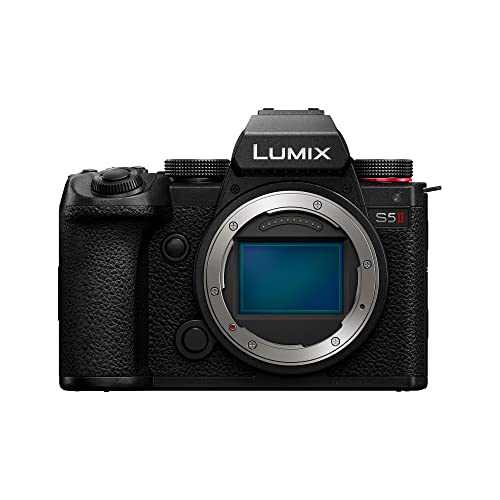
The Panasonic Lumix S5II is a full-frame hybrid camera that was designed with video in mind but still handles photography well. It was the first Lumix body to add phase-detection autofocus, which addressed the most common criticism of earlier Panasonic cameras, and it keeps the brand’s reputation for long recording times and generous video features. This page walks through what Panasonic says about the camera, who it suits and who should look elsewhere. For the whole field, see our ranking of the best mirrorless cameras of 2026.
We have not handled this camera and we take no measurements of our own. What follows compares the published specifications and Panasonic’s descriptions. Where Panasonic does not list a number on the page we read, we say so instead of guessing.
Sensor and Image Quality
According to Panasonic, the S5II has a 24.2-megapixel full-frame CMOS sensor with an ISO range of 100 to 51200 and Dual Native ISO, a design that uses two circuit settings to keep noise down in dim light. Twenty-four megapixels is a sensible resolution for most photographers: files stay manageable, and the pixels are large enough to help in low light. If you print very large or crop heavily, a higher-resolution body such as the Fujifilm X-T5 has more room to work with, though it uses a smaller APS-C sensor.
Autofocus
The most important change in this generation is autofocus. Panasonic lists a 779-point phase-detection hybrid system. Earlier Lumix bodies relied on contrast detection, which could hunt for focus on moving subjects. Phase detection gives the camera a sense of distance and direction, so it can track a subject with less back-and-forth.
Panasonic says firmware 3.0 added animal, car and motorcycle eye recognition, and also a pre-burst shooting function. Firmware updates are free, so a body that has been on the market for a while can gain features. Check that your camera is running the latest version after you unpack it.
Stabilization for Photos and Video
Panasonic lists 5-axis image stabilization for stills. For video, the page describes Active I.S., which compensates for movement during handheld shooting, and electronic image stabilization that reduces distortion toward the edges of the frame. The page we read does not give a CIPA stop rating, so we do not quote one.
Video Capabilities
Video is the S5II’s strongest card. Panasonic lists:
- Unlimited 6K 30p 4:2:0 10-bit recording.
- C4K and 4K 60p 4:2:2 10-bit recording.
- Real-time LUT recording, which bakes a color look into the footage.
The word “unlimited” has conditions. Panasonic’s page says recording may stop when the temperature is outside 32 to 104 degrees Fahrenheit (0 to 40 degrees Celsius), and that in 6K and 5.9K modes recording stops after 30 minutes when Thermal Management is set to Default. In other words, you need to change a menu setting to get the longest recording times. Read the manual before you rely on the camera for an event where you cannot restart the take.
Panasonic describes a new optimized heat dissipation structure for the camera. We cannot say how much of the body’s size comes from it, but the S5II is clearly larger than the compact full-frame cameras in our ranking.
Burst Shooting
Panasonic lists continuous shooting of up to 30 frames per second. As with any figure like that, the conditions matter: shutter type, file format and focus mode all affect what you actually get. The page also mentions a pre-burst function from firmware 3.0, which records frames from before you fully press the shutter. For fast action, our ranking places stacked-sensor bodies with deeper buffers higher, but the S5II is a capable all-rounder for everyday action such as kids and pets.
Viewfinder, Screen and Cards
Panasonic lists a 3.68-million-dot OLED viewfinder with 0.78x magnification and a 3.0-inch free-angle touchscreen. A free-angle screen swings out and rotates, so it works for vlogging, low-angle shots and overhead framing.
The camera has dual UHS-II SD slots. Two slots matter more than many buyers realize: you can record to both cards at once for a backup, or send photos to one and video to the other. Some compact full-frame bodies have only a single slot, which is something to weigh if you shoot weddings, events or client work.
Build, Size and Weight
Panasonic describes a magnesium alloy body with dust and splash resistance. It lists about 1.63 lb (740 g) body only, and dimensions of about 5.29 by 3.55 by 4.03 inches (134.3 by 90.1 by 102.3 mm). That is heavier than the Sony a7C II, which Sony lists at about 18.1 oz with battery and card. The extra heft buys a larger grip, dual card slots and the cooling design, but if you travel light it is a real consideration. Think in terms of a full day of carrying, not the spec sheet.
Connectivity and Power
The page lists Wi-Fi, Bluetooth and a 12 V external power input option for studio and broadcast use. Panasonic’s page does not list the battery rating, so check the listing for the battery type and expected shots per charge if all-day shooting matters to you.
Who Should Buy the S5II
The camera is a strong match if you:
- Shoot video as often as photos, especially interviews, events, travel films and YouTube.
- Want dual card slots without moving to a flagship body.
- Prefer a larger body with a deep grip and a lot of physical controls.
- Are open to the L-Mount system, which also includes lenses from other brands.
- Value firmware updates that add features over time.
Who Should Look Elsewhere
If you want the smallest, lightest full-frame body, the Sony a7C II is the more portable choice.
If you want the broadest lens selection and third-party options, Sony E-mount and Canon RF have larger catalogs than L-Mount. Check that the lenses you want exist before you commit to a mount.
If you are on a tight budget, the Nikon Z50II and Canon EOS R50 are APS-C bodies that cost far less and weigh much less.
If you need the very fastest autofocus and burst rates for sports and wildlife, look higher in our full ranking.
Ownership Costs to Plan For
The body is sold without a lens, so plan for at least one lens, extra batteries, two fast UHS-II SD cards if you want to use both slots, and a bag that fits a larger body. Because we do not list prices on this site, use the button below to see the current listing and the exact configuration on Amazon.
How It Compares With Its Neighbors
In our ranking, the Lumix S5II is a mid-range full-frame option that leans toward video. It sits below the newest hybrids such as the Sony a7 V and Canon EOS R6 Mark III, which offer faster sensors, and it is larger than the Sony a7C II. It offers a second card slot and longer recording options than the more compact bodies, at the cost of size and weight.
Bottom Line
The Panasonic Lumix S5II is not the lightest or the fastest full-frame camera, but it is one of the most complete for hybrid shooters. It pairs a 24.2-megapixel sensor with a 779-point phase-detection autofocus system, 5-axis stabilization, long 10-bit recording and dual card slots. If you value those things over portability, it deserves a place on your shortlist.
See price on Amazon
Sources