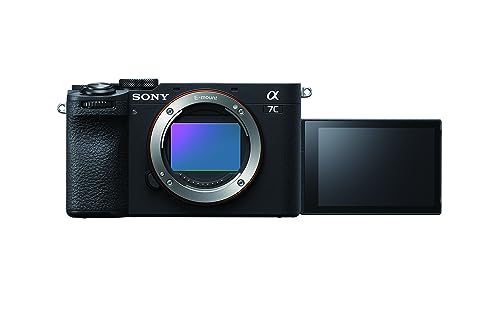
The Sony a7C II is built for photographers who want a full-frame sensor without the heft that usually comes with one. Sony announced it in August 2023 alongside the higher-resolution a7CR, and it sits in the middle of the full-frame range: more capable than an entry-level body, smaller than most of its peers. This page goes through what Sony says about the camera, who will be happy with it, and where something else makes more sense. For the full field, see our ranking of the best mirrorless cameras of 2026.
We have not handled this camera and we take no measurements of our own. What follows compares the specifications and descriptions in Sony’s launch release. Where Sony does not publish a number in that release, we say so instead of guessing.
Sensor and Processor
According to Sony, the a7C II uses a full-frame back-illuminated Exmor R CMOS sensor with about 33.0 effective megapixels, paired with the latest BIONZ XR image processing engine. Thirty-three megapixels is a comfortable middle: enough detail for large prints and for cropping into a frame, without the file sizes of a 60-megapixel body.
Back-illuminated designs move the wiring behind the light-sensitive layer, which is the usual reason makers choose them for low-light performance. Sony does not publish a low-light claim for the a7C II in the release we read, so we leave that comparison to independent sample galleries.
Autofocus and the AI Processing Unit
The headline feature is the AI processing unit. Sony says it is the same unit found in the Alpha 7R V and that it powers Real-time Recognition AF. According to the release, the camera can use human pose estimation to keep following a person even when the face is hidden or the person is in a complicated pose. Beyond people and animals, Sony says the camera now recognizes birds, insects, cars, trains and airplanes.
In practical terms, this is the autofocus you would want for family photos, travel, street scenes and casual wildlife. You choose the subject type, and the camera tracks it. If you mostly photograph fast-moving sports or birds in flight, the autofocus is only part of the picture, because burst speed, buffer depth and lens choice matter just as much. Sony’s release does not list a burst rate, so check the full specification sheet on Sony’s site or the Amazon listing if that matters to you. For wildlife and sports, our ranking favors bodies with faster published burst rates.
Image Stabilization
Sony lists 5-axis in-body image stabilization with a CIPA figure of 7.0 stops, measured on pitch and yaw with the FE 50mm F1.2 GM lens. CIPA figures come from a standardized procedure, but they describe a best case with a particular lens, so treat the number as a reference point and not as a guarantee for every lens you mount.
For video, Sony also lists an Active Mode that combines in-body stabilization with electronic correction for a steadier handheld look. That is useful for walking shots, though it usually comes with an extra crop into the frame.
Video Features
The a7C II is not only a photo camera. Sony says it records 4:2:2 10-bit video up to 4K 60p, with 60p and 50p available only in Super 35mm mode. Sony’s own wording for the video quality is that it condenses data equivalent to 7K into 4K output, which is the oversampling approach many makers use to get cleaner detail.
Other video features in the release include:
- S-Log3, which Sony says offers 14 or more stops of latitude, for grading in post.
- S-Cinetone, Sony’s cinema-inspired color look, for footage that needs less work.
- A digital audio interface, which supports compatible Sony microphones and accessories through the shoe.
- LUT display while shooting in Log, so you can preview a graded look.
- AI-based auto-framing, which can follow a subject and keep them centered.
This is a capable video toolkit for a camera of its size. If video is your main reason to buy, though, compare it against bodies built around longer recording and heat management. Our Lumix S5II profile covers one such alternative, and the Sony ZV-E10 II profile covers a cheaper creator-focused option.
Viewfinder, Screen and Controls
Sony says the camera has an XGA high-resolution electronic viewfinder and a touch-operable vari-angle LCD with a touch menu. A vari-angle screen swings out to the side and rotates, which makes it easier to frame yourself for vlogs or to shoot at awkward angles than with a screen that only tilts.
The body carries a new front dial and a still, movie and slow-and-quick mode dial, which lets you switch modes without opening a menu. Sony says the dimensions are about 4.88 in wide, 2.8 in high and 2.5 in deep.
Size and Weight
This is the point of the camera. Sony lists about 18.1 oz including the battery and a memory card, and says the body is about 22 percent lighter and has about 45 percent less volume than the a7 IV. That is a meaningful difference in a bag, particularly for travel, hiking and long days on foot.
Remember that the body is only part of the load. Full-frame lenses are larger than APS-C lenses, so a compact body paired with a big zoom can still feel front-heavy. Many owners of compact full-frame bodies pair them with small prime lenses to keep the whole kit light.
What the Launch Release Does Not Say
A few items buyers usually want are not in the release we read: the number of card slots, the battery rating, the burst rate and the amount of heat the camera can take during long recordings. We have not guessed at any of them. Before you order, open Sony’s full specification page or the Amazon listing and check the items that matter to you, especially card slots if you shoot paid work that needs a backup card.
Who Should Buy the a7C II
The camera is a strong match if any of these describe you:
- You want full-frame image quality and E-mount lens choice in the lightest body practical.
- You travel a lot and need a camera that disappears into a small bag.
- You photograph people, pets and everyday scenes and want autofocus that holds on to a subject.
- You make occasional videos and want 10-bit 4:2:2 and Log in a small camera.
- You are moving up from an APS-C body and want to keep using Sony E-mount lenses.
Who Should Look Elsewhere
If you shoot long events or interviews where a recording cannot stop, look at bodies with published thermal features, such as the Lumix S5II, where Panasonic describes unlimited recording in certain modes.
If you are on a tighter budget or just starting, an APS-C body such as the Canon EOS R50 or the Nikon Z50II costs much less, and the lenses are smaller and cheaper too.
If you need the fastest burst rates and pre-capture for sports or wildlife, our full ranking places newer stacked-sensor bodies higher for that job.
Ownership Costs to Plan For
The body is only the start. Budget for a lens, since the body is sold on its own, plus at least one extra battery if you shoot all day, a fast SD card, a camera bag and a screen protector. Because we do not list prices on this site, use the button below to see the current listing and the exact configuration on Amazon.
How It Compares With Its Neighbors
Within our ranking, the a7C II is a compact full-frame option that sits below the newest flagship-class hybrids, the Sony a7 V and the Canon EOS R6 Mark III, and above the APS-C bodies. It trades the speed and top-end video of the newer bodies for portability. Against the Panasonic Lumix S5II, the Sony is smaller and lighter, while the Panasonic is a bulkier body aimed more at video. Against the cheaper APS-C bodies, it offers a larger sensor and stronger stabilization, but you pay more for both the body and the lenses.
Bottom Line
The Sony a7C II is a sensible choice if the main reason you have not bought a full-frame camera is size. According to Sony, it combines a 33-megapixel full-frame sensor, an AI-assisted autofocus system, 5-axis stabilization and a body of about 18.1 oz. Check the card slot count and burst figures on Sony’s spec sheet, pick a lens that matches your subjects, and you have a camera that is easy to take everywhere.
See price on Amazon
Sources