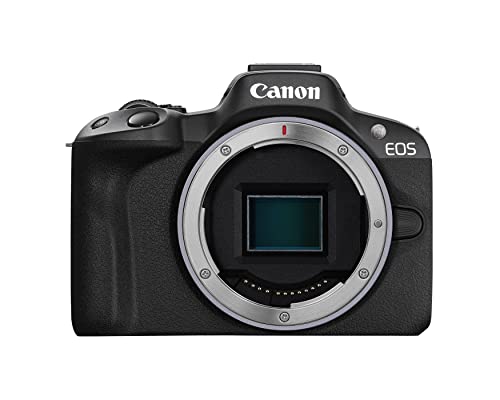
The Canon EOS R50 is the camera many people picture when they want to move up from a phone without carrying something heavy. It is a small APS-C mirrorless body that uses Canon’s RF mount, and it is built around automatic features that help new photographers get sharp pictures. This page goes through what Canon says about the camera, who it fits and who should look elsewhere. For the whole field, see our ranking of the best mirrorless cameras of 2026.
We have not handled this camera and we take no measurements of our own. What follows compares the specifications on Canon’s specification page. Where Canon does not list a number, we say so instead of guessing. The listing here is for the body only, so you will need to add a lens.
Sensor and Processor
Canon lists a 24.2-megapixel (effective) APS-C CMOS sensor and the DIGIC X processor. APS-C is the most common sensor size for entry-level and mid-range interchangeable-lens cameras, and 24 megapixels is plenty for large prints and for cropping. The ISO range for stills runs from 100 to 32,000, expandable to 51,200, and for movies from 100 to 12,800 (25,600 expanded), according to Canon.
Autofocus
Autofocus is the R50’s biggest strength for its size. Canon lists Dual Pixel CMOS AF II with EOS iTR AF X subject detection for people, animals and vehicles, up to 651 AF zones and eye detection. For beginners, the practical meaning is that the camera finds a face or an animal and keeps it sharp while you concentrate on the moment. Modes include One-Shot, AI Focus for stills, and Servo, with Movie Servo for video.
Burst Shooting
Canon lists up to 15 fps with the electronic shutter and 12 fps with electronic first curtain, and notes that shooting slows if flicker is detected. Those are fast numbers for a small camera, good enough for kids, pets and casual sports. They are not a match for the stacked-sensor bodies at the top of our ranking, which handle faster action and deeper buffers, and Canon’s page does not list a pre-capture function.
Video Features
Canon lists 4K 30p oversampled from 6K, Full HD up to 120p, MP4 files, HDR PQ and Movie Digital IS, an electronic stabilization mode for video. An IPB Full HD 30p mode at a lower bit rate is also listed for smaller files.
The limits are worth knowing. There is no 4K 60p on this model, and without in-body stabilization, handheld footage will look steadier with a stabilized lens, a gimbal or the electronic mode (which usually costs a small crop). For social clips and family videos, the R50 is more than enough. For serious video work, look at the Sony ZV-E10 II, which lists 4K up to 60p and a set of creator tools, or at the Nikon Z50II.
Viewfinder and Screen
Canon lists a 0.39-inch OLED electronic viewfinder with about 2.36 million dots, 100 percent coverage and refresh rates of 59.94 or 119.88 fps. The rear screen is a 3.0-inch fully articulating touchscreen with about 1.62 million dots. A fully articulating screen flips out to the side and rotates, so you can frame yourself, shoot over a crowd or work at ground level. A viewfinder helps outdoors, where a screen can wash out in sunlight, and many cameras this small skip it.
Size, Weight and Controls
Canon lists about 13.2 oz (375 g) in black or 13.3 oz (376 g) in white, including the battery and memory card. The camera uses an LP-E17 battery, and it has a single SD card slot that is UHS-I compatible. The port selection is USB Type-C (at USB 2.0 Hi-Speed level), a microphone input, micro HDMI and a Multi-function Shoe.
The small body means a small grip and fewer buttons than larger cameras. Some people love that. If you have large hands, or you like a lot of dials, try one in a store or compare it with the Nikon Z50II, which Nikon lists at about 19.4 oz (550 g) with battery and card and which has a dedicated Picture Control button.
The Lens Question
The body in this listing is sold without a lens. Canon launched the R50 with a compact RF-S 18-45mm zoom as a kit lens, a sensible all-around choice for portraits, landscapes and travel. Check the listing on Amazon to see what is currently available.
RF-mount lenses are an investment. Canon’s RF system includes full-frame lenses that also fit APS-C bodies like the R50, which gives you room to grow, but they are larger and more expensive than the small RF-S lenses designed for the R50. Many owners start with the kit zoom and add a fast prime for portraits and low light.
Who Should Buy the EOS R50
The camera is a strong match if you:
- Want a first interchangeable-lens camera that is light and easy.
- Take mostly family photos, travel pictures and casual video.
- Like autofocus that finds faces and animals without fuss.
- Want a viewfinder and a flip-out screen in a small body.
- Plan to grow into Canon’s RF lens system.
Who Should Look Elsewhere
If you need in-body stabilization for handheld video or slow shutter speeds, look at the Sony a7C II, which lists 5-axis in-body stabilization in a compact full-frame body.
If you want 4K at 60p, the Sony ZV-E10 II and the Nikon Z50II list it.
If you plan to shoot fast action or wildlife, a body with a faster sensor and a bigger buffer will frustrate you less. Check the upper half of our full ranking.
If you shoot paid events and need a backup card, a body with dual slots such as the Lumix S5II is a better fit.
Ownership Costs to Plan For
Plan for a lens, an extra LP-E17 battery, a fast SD card, a strap or bag and, if you vlog, an external microphone. Because we do not list prices on this site, use the button below to see the current listing and the exact configuration on Amazon.
How It Compares With Its Neighbors
In our ranking, the EOS R50 sits at the entry end of the APS-C group, next to the Sony ZV-E10 II and the Nikon Z50II. It is the lightest of the three by Canon’s, Sony’s and Nikon’s published figures with battery and card (about 13.2 oz against about 13.3 oz and about 19.4 oz), though only just against the Sony. It lacks the 4K 60p and the extra creator features of the others. Higher in the ranking, the Sony a6700 and Fujifilm X-T5 are more advanced APS-C cameras with in-body stabilization, aimed at enthusiasts.
Bottom Line
The Canon EOS R50 does the basics well: it has a sensor large enough for good pictures, autofocus that finds faces and animals, a viewfinder, a flip-out screen and a body that weighs about 13 oz. It leaves out in-body stabilization and 4K 60p, which keeps it small. If you want a simple first camera that you will actually carry, it is a sensible place to start.
See price on Amazon
Sources